
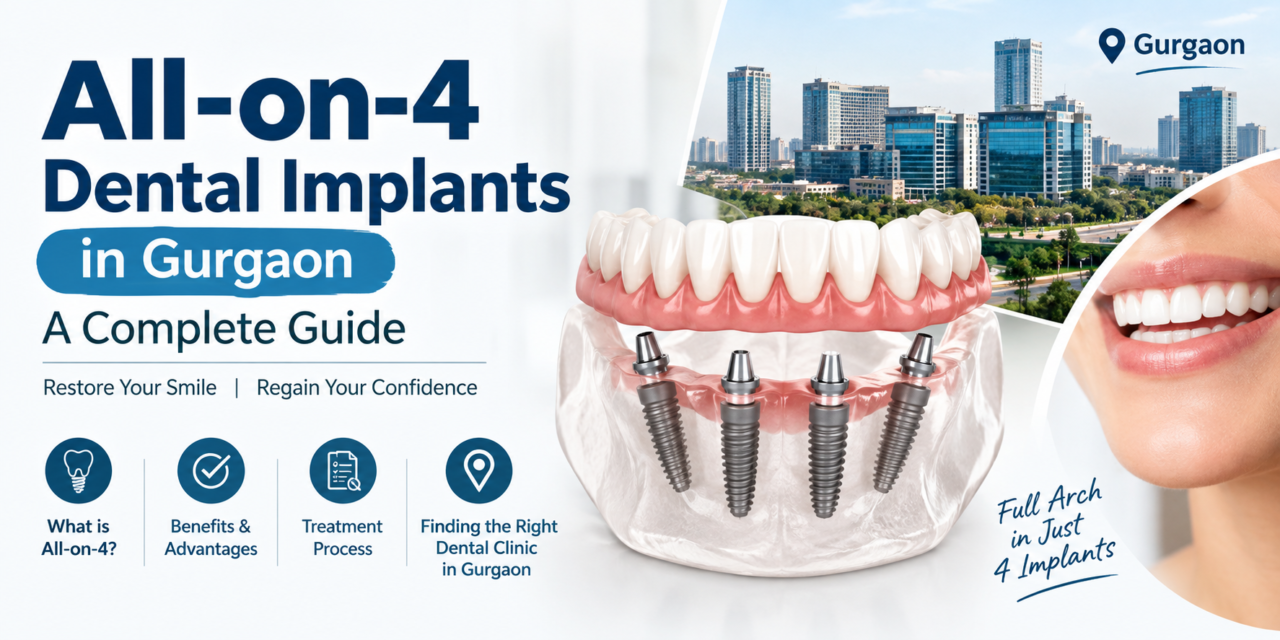
If you have lost most or all of your teeth in one jaw, All-on-4 implants let you replace that entire arch with a fixed, natural-looking set of teeth anchored on just four posts. At Cusp Dental, we plan and place this treatment for patients across Gurgaon who want a permanent alternative to removable dentures. Here is what the procedure involves, who it suits, and what to expect at every stage.
What Are All-on-4 Dental Implants?
All-on-4 dental implants are a full-arch tooth replacement system that anchors an entire set of prosthetic teeth to four surgically placed posts instead of one implant per missing tooth. Two go in at the front of the jaw in a vertical position, and two are angled toward the back, where bone volume tends to run lower after years of tooth loss. This angled placement lets your dentist use the bone you already have, which often removes the need for a separate grafting procedure.
The result is a fixed bridge that looks, feels, and functions like natural teeth. You do not remove it at night, and you do not soak it in a glass. Once your dentist secures it in place, it stays put the same way natural teeth do.
How Do All-on-4 Dental Implants Work?
This system works by distributing the entire bite force of an arch across four strategically angled titanium posts. The two rear implants tilt at roughly 30 to 45 degrees. That angle increases contact with the jawbone, so the structure can hold a full prosthesis right after placement.
Titanium also fuses directly with living bone through a process called osseointegration. Bone cells grow around the implant surface over several months and lock it in place. The result is a prosthesis strong enough for daily use, one that stays put whether you are biting into an apple or talking through a long meeting.
What Happens During the All-on-4 Dental Implants Procedure?
Your dentist begins with a clinical exam, dental X-rays, and a 3D CT scan to map your jawbone density, nerve position, and sinus location before confirming this as the right treatment. That imaging lets the dental team plan the exact angle and depth for each implant before any surgery takes place.
On the day of surgery, your dentist removes any remaining damaged teeth in the arch, places the four implants at their planned positions, and attaches a temporary fixed bridge the same day. You leave with functional teeth rather than a gap or a removable denture while healing takes place.
Over the following three to six months, osseointegration secures the implants fully. Your dentist then swaps the temporary bridge for a custom-fitted permanent prosthesis, built from impressions and scans taken once healing is complete.
What Are the Benefits of All-on-4 Dental Implants?
Patients choose this treatment for several clinical and practical reasons:
- Fewer implants, full-arch coverage: Four posts support an entire arch, lowering surgical time and cost compared with six to eight individual implants.
- Same-day function: You walk out of your first appointment with fixed teeth rather than an empty socket healing period.
- Reduced need for grafting: The angled rear implants use denser bone that traditional implants often cannot reach, helping patients with moderate bone loss skip a separate grafting surgery.
- Stable, fixed bite: The prosthesis anchors directly to bone, patients regain a bite force close to natural teeth, unlike dentures that shift while eating or speaking.
- Long-term bone support: Implants stimulate the jawbone during chewing, slowing the bone loss that follows extraction and denture wear.
Who Is a Candidate for All-on-4 Implants?
Good candidates for this treatment are adults missing most or all of their teeth in one or both arches, whether from advanced gum disease, extensive decay, injury, or long-term denture wear. Sufficient bone density at the front of the jaw is necessary for stable anchorage, though the angled placement approach lets many patients qualify without needing bone grafting first.
Some conditions call for closer evaluation before treatment begins. Uncontrolled diabetes slows healing. Active gum infection needs to clear first. Heavy smoking interferes with how well an implant bonds to bone. Your dentist checks your medical history and takes jawbone scans to work out whether All-on-4 fits your case now, or whether treating an underlying issue first gets you there.
All-on-4 vs Traditional Dental Implants: What’s the Difference?
Traditional dental implants replace teeth on a one-to-one basis. A patient missing eight teeth in an arch would typically need eight individual implants, each with its own healing period before the final restoration goes on. All-on-4 takes a different route: four implants support one connected bridge across the entire arch, which means fewer surgical sites and a shorter overall timeline.
The right choice comes down to how much of the arch you have lost. Missing only a few scattered teeth calls for individual implants, since they replace what’s gone without touching healthy neighboring teeth. Losing most or all of an arch is where this treatment earns its place. You get one coordinated bridge instead of several separate procedures, each with its own recovery window. Our team at Cusp Dental reviews your specific tooth loss pattern and bone condition through our All-on-4 dental implants in Gurgaon service before recommending either approach.
How Long Do All-on-4 Implants Last?
Titanium posts commonly last 20 years or longer. Many patients keep the same set for life, provided they stick to regular checkups and daily hygiene. The prosthetic bridge is different: it typically holds up for 10 to 15 years, because the acrylic or porcelain material wears down with daily use. At that point, it needs replacement or relining.
Long-term success depends on how well you care for the implants. Clean around the implant base every day. Keep up with your professional maintenance visits. Treat any gum inflammation as soon as it shows up, since inflammation left alone is what erodes the bone holding the implants in place.
What Does All-on-4 Dental Implants Recovery Look Like?
Swelling and mild bruising are normal for the first three to five days after surgery. Some tenderness lingers too, and prescribed medication combined with a soft-food diet keeps it manageable. Soft, non-chewy foods are the rule for the first six to eight weeks, while the implants fuse with bone. After that, firmer foods can return to your diet a little at a time.
Full osseointegration takes three to six months. Your dentist checks implant stability at scheduled follow-up visits throughout that period. Once healing is confirmed through imaging, your dentist fits the final, permanent prosthesis in place of the temporary bridge.
Frequently Asked Questions
Does the All-on-4 procedure hurt?
Local anesthesia keeps the surgery itself pain-free, though you feel pressure as your dentist works. Soreness shows up afterward, usually peaking around the second day, and prescribed medication keeps it under control.
Can I still get All-on-4 implants if I have significant bone loss?
Often, yes. The angled rear implants reach denser bone that traditional implants cannot access, which lets many patients with moderate bone loss skip grafting entirely. Your CT scan at consultation settles the question for your specific jaw.
How much does All-on-4 treatment cost in Gurgaon?
Pricing depends on how many arches need treatment, which prosthesis material you choose, and whether your jawbone needs preparatory work first. We put together an exact quote only after reviewing your consultation and imaging.
What happens if an All-on-4 implant fails?
True implant failure is rare among patients who follow post-surgical care and keep their follow-up visits. Smoking and uncontrolled diabetes raise that risk considerably. Regular monitoring means your dentist spots warning signs long before failure becomes likely.
How do I clean All-on-4 implants at home?
Twice-daily brushing with a soft-bristled brush covers the prosthesis and gumline. A water flosser or interdental brush clears out debris trapped beneath the bridge, somewhere a regular toothbrush cannot reach. Add a professional cleaning every six months.
Is All-on-4 covered by dental insurance in India?
Rarely in full. Most Indian insurers treat implant-based treatments as elective, so coverage tends to be limited or absent. We walk you through the available payment options at your consultation, before cost becomes a surprise.
All-on-4 dental implants give patients with significant tooth loss a fixed, functional, and long-lasting alternative to dentures, backed by a treatment process built on careful planning and precise surgical placement. If you are exploring your options for full-arch tooth replacement in Gurgaon, our team at Cusp Dental Clinic is ready to review your case, explain what suits your jawbone and health history, and guide you toward the right treatment. Reach out to book a consultation and get a clear picture of your smile restoration options.
