
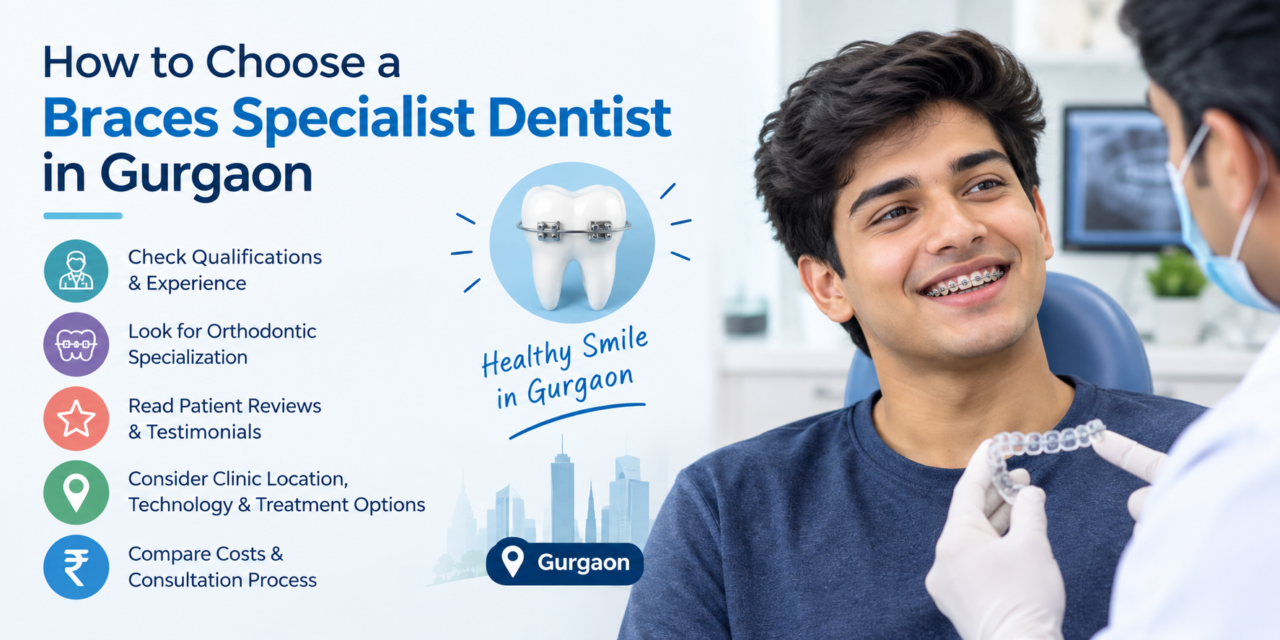
Choosing a braces specialist dentist in Gurgaon comes down to checking three things: their orthodontic training beyond a general dental degree, their hands-on experience with cases similar to yours, and whether they walk you through options instead of pushing one. Braces treatment usually runs anywhere from several months to a couple of years, so the person planning it matters as much as the brand of braces you end up wearing.
What Does a Braces Specialist Actually Do?
A braces specialist, more accurately called an orthodontist, diagnoses and corrects the position of teeth and jaws using braces, aligners, or other appliances. This goes beyond a general dentist’s scope. Orthodontists complete additional years of training focused specifically on tooth movement, bite correction, and jaw growth, and that extra training is what lets them plan multi-year cases with predictable outcomes.
General dentists can place basic aligners for mild cases. Complex bite issues, jaw discrepancies, or cases needing extractions are a different story and call for an orthodontist’s judgment, not a general dentist stretching into unfamiliar territory. That distinction is really the starting point for how to choose an orthodontist: find out whether the person in front of you has that specialized training, or whether braces are just one more service added to a general practice’s menu.
Signs You Need Braces
You may need braces if you notice crowded or overlapping teeth, visible gaps between teeth, or a bite where your upper and lower teeth don’t meet evenly when you close your mouth. Other signs include jaw clicking, difficulty chewing on one side, or teeth that have shifted noticeably compared to a few years ago.
Some of these signs are cosmetic. Others point to functional problems that get harder to correct the longer they’re left. A crowded lower arch, for instance, tends to get tighter with time rather than resolving on its own. If you’re noticing two or more of these signs together, it’s worth getting an actual assessment instead of guessing whether your case is serious enough to bother with.
How to Choose a Braces Specialist Dentist in Gurgaon
How to choose a braces specialist dentist in Gurgaon starts with verifying their orthodontic qualifications and checking how many years they’ve spent treating cases like yours, not just how modern their clinic looks. Gurgaon has no shortage of clinics offering braces, but training, case volume, and the technology behind the treatment plan vary a lot between them.
A handful of details separate a genuinely qualified specialist from someone who simply added braces to their price list:
- Where they trained, and whether that training was orthodontics specifically, not general dentistry
- How many years they’ve spent treating braces and aligner cases, not dentistry in general
- Whether treatment planning relies on X-rays and 3D imaging, or just a visual estimate
- How clearly they walk you through your specific case, including what could go wrong
For comparison, our doctors at Cusp Dental Clinic trained at PGI Chandigarh and AIIMS Delhi, and the clinic’s Black Diamond+ Invisalign provider status came from case volume and outcomes over several years, not from a certificate on the wall.
How to Choose an Orthodontist: Key Qualifications to Check
Choosing the right specialist really comes down to verifying credentials rather than trusting a clinic’s marketing. Ask specifically whether the dentist treating you completed a postgraduate specialization in orthodontics, and how many years they’ve practiced since. A dentist who occasionally fits braces alongside general dentistry work has a different depth of experience than one who treats orthodontic cases every day.
Case volume matters more than most patients realize going in. An orthodontist who has managed hundreds of cases has likely encountered the specific complication your case might present, whether that’s a stubborn tooth that won’t rotate or a bite that needs more than the standard adjustment schedule. That pattern recognition doesn’t come from a certificate. It comes from repetition.
What to Look For in a Braces Specialist
What to look for in a braces specialist beyond qualifications is how they communicate during the first meeting. A good specialist explains your specific misalignment, shows you your own X-rays or scans, and gives you a realistic timeline rather than a rounded-off estimate. Watch for whether they discuss more than one treatment option or immediately push toward whichever appliance the clinic happens to sell hardest.
An experienced braces specialist also tells you what your case can’t achieve, not just what it can. If your jaw structure limits how far teeth can move without surgery, you deserve to hear that upfront rather than discovering it partway through treatment.
Questions to Ask an Orthodontist Before Starting
Before you agree to anything, a few questions to ask an orthodontist can cut through the sales pitch and get you real answers on timeline, cost, and what happens if things don’t go as planned:
- How long will my specific case take, based on my X-rays and bite?
- What happens if my teeth don’t respond as planned partway through?
- Which type of braces suits my case, and why that one over the alternatives?
- What does the total cost include, and are retainers part of that?
- How often will I need to come in for adjustments?
An experienced braces specialist answers these directly, with reasons specific to your teeth, not generic responses that would apply to any patient walking through the door.
Types of Braces: Which One Might Suit You?
Types of braces available today range from traditional metal brackets to nearly invisible options. Metal braces cost the least and hold up well even in complicated cases, which is part of why plenty of orthodontists still default to them. Ceramic braces do a similar job with tooth-colored brackets that blend in more. If visibility bothers you, lingual braces sit behind the teeth entirely, so nothing shows from the front. Clear aligners are a different approach entirely. Instead of fixed brackets, you get a series of removable trays, which works well for mild to moderate crowding but tends to fall short once a case gets more severe. Which one actually fits you depends on your bite, your budget, and honestly, how much you mind people seeing metal in your mouth for a year or two.
What Happens During an Orthodontic Treatment Consultation?
An orthodontic treatment consultation typically includes a clinical exam, X-rays or a 3D scan, and a discussion of the treatment options suited to your bite and alignment. Most consultations run 30 to 45 minutes and end with a written plan covering timeline, appliance type, and cost.
Come prepared with questions about your specific concerns, whether that’s how braces will affect your daily routine or how visible the appliance will be at work or school. A properly run orthodontic treatment consultation should leave you with a clear next step, not a vague recommendation to “think about it.”
How Do You Know You’ve Found the Best Orthodontist for Braces?
The best orthodontist for braces for your case is the one who gives you a specific, documented plan rather than a general one, explains trade-offs honestly, and has treated enough similar cases to back up their recommendation. Credentials matter, but so does whether you actually understood the plan they gave you by the time you left the room.
Frequently Asked Questions
At what age should someone see an orthodontist?
Most orthodontists recommend a first evaluation around age seven, even if treatment doesn’t start immediately. Early evaluation catches jaw growth issues while they’re easier to manage, though adults can start orthodontic treatment at any age.
How long does braces treatment usually take?
Most patients finish somewhere between 12 and 24 months, though that range shifts depending on how much correction you actually need. Mild cases sometimes wrap up faster with clear aligners, while a complex bite can run past the two-year mark.
Do braces hurt?
Not really, though the two or three days after each adjustment usually bring some soreness. It reads more like pressure or tightness than actual pain, and it settles on its own within a few days.
Can adults get braces?
Yes, adult orthodontic treatment is common and works the same way biologically as it does for teenagers, just sometimes over a slightly longer timeline depending on bone density and existing dental work.
Is a second opinion worth getting?
For anything beyond a straightforward case, yes. A second consultation costs little compared to committing a year or more to a plan that wasn’t the best fit for your teeth.
Ready to Talk to a Specialist About Your Teeth?
If you’re weighing your options for braces or aligners in Gurgaon, an in-person assessment with an experienced braces specialist tells you far more than any article can. Cusp Dental Clinic’s team, trained at institutions including PGI Chandigarh and AIIMS Delhi, can walk you through what treatment would actually look like for your bite. Our Invisalign and braces treatment options are covered in more detail there, or you can book a consultation to get a plan specific to your teeth.
