
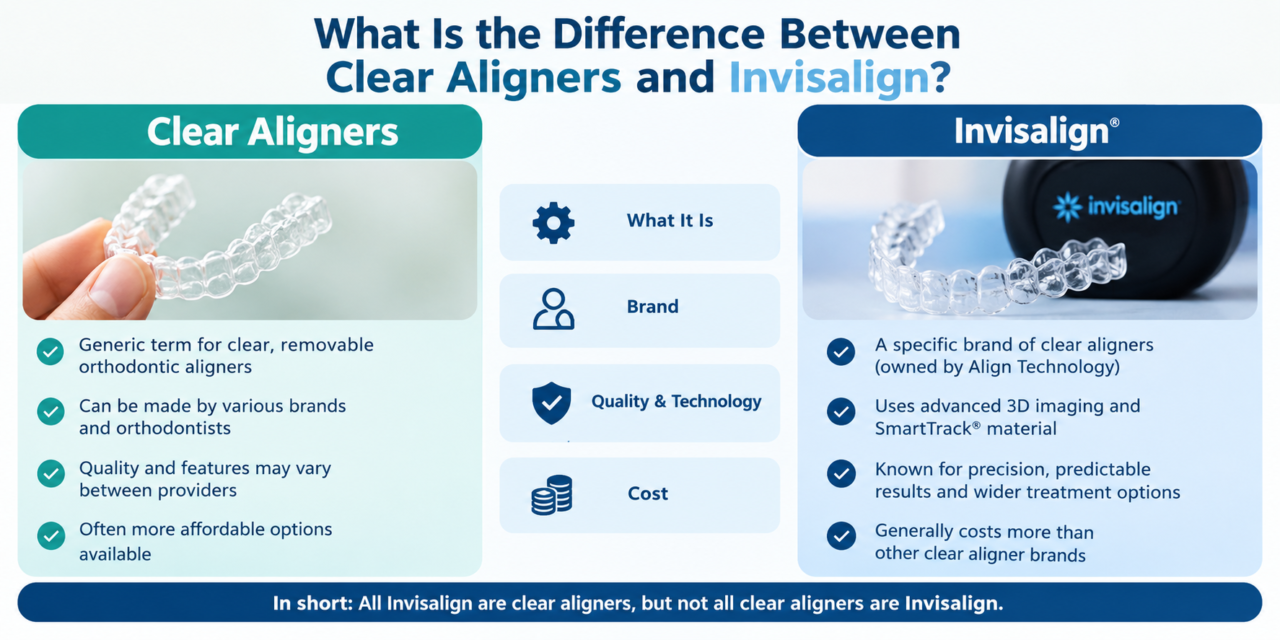
If you have been looking into straightening your teeth without metal braces, you have probably run into two terms that seem to mean the same thing: clear aligners and Invisalign. At Cusp Dental, patients ask us this almost every week. The short version is that Invisalign is a brand of clear aligners, not a separate category of treatment, but the details matter when you are deciding what to spend your money on. In this guide, we will break down what clear aligners are, what makes Invisalign different, how the two compare on cost and treatment time, and how to choose between them for your smile.
What Are Clear Aligners?
Clear aligners are transparent, removable trays that gradually shift your teeth into position. Instead of wires and brackets, you get a series of custom-fitted trays, each one slightly different from the last, that you swap out every one to two weeks. Every company that makes them, from budget mail-order brands to premium clinical systems, falls under this umbrella term.
Here is what most clear aligner systems have in common:
- They are made from medical-grade plastic that is molded to fit your teeth.
- You wear them for 20 to 22 hours a day and remove them to eat and brush.
- Each tray in the series is calibrated to push your teeth a fraction of a millimeter further than the last one.
- Most people you talk to will not even notice you are wearing them.
The quality gap between brands is where things get tricky. A lot of mail-order clear aligner companies scan your teeth once, ship you a full set of trays, and check in only if something feels wrong. At Cusp Dental, a dentist reviews your scans before treatment starts and checks your progress at set intervals, so if a tray is not fitting the way it should, we catch it early instead of waiting for you to notice halfway through.
What Is Invisalign?
Invisalign is a specific brand of clear aligners made by Align Technology. It is not a generic term, even though a lot of people use it that way, much like people say “Xerox” when they mean any photocopier. Invisalign was one of the first companies to bring clear aligner treatment to the market, and it has since built a large library of clinical data behind its system.
What sets Invisalign apart is the technology behind the plan. Your dentist takes a digital scan of your teeth, and that feeds into Invisalign’s software, which maps out every stage of your treatment before a single tray is made. You can see a rough preview of your future smile before you commit. Invisalign also offers several product lines, including options for teens, mild cases, and more complex bite corrections.
Clear Aligners vs Invisalign: What Is the Difference?
The clearest way to understand the difference between clear aligners and Invisalign is to lay them side by side. One is a category, the other is a specific product within that category.
| Factor | Clear Aligners | Invisalign |
| Meaning | General category | Specific branded system |
| Manufacturer | Different companies | Align Technology |
| Customisation | Depends on provider/system | Custom treatment planning |
| Technology | Varies | Invisalign’s digital treatment system |
| Treatment options | Varies | Multiple Invisalign treatment options |
As the table shows, when we talk about clear aligners vs Invisalign, we are really comparing a broad category against one well-established name inside it. Every Invisalign tray is a clear aligner, but not every clear aligner is Invisalign.
Are Invisalign and Clear Aligners the Same Thing?
No, they are not exactly the same thing. Clear aligners is the umbrella term for any brand of transparent, removable orthodontic trays. Invisalign is one specific brand under that umbrella, made by Align Technology and backed by its own scanning software and treatment planning process.
Benefits of Invisalign Clear Aligners
Patients choose Invisalign clear aligners over generic alternatives for a few practical reasons:
- Detailed treatment mapping. You get a digital preview of your smile before treatment starts, so there are no surprises halfway through.
- Wide case coverage. Invisalign can treat minor spacing issues as well as more involved bite problems, which is not true of every low-cost aligner brand.
- Established track record. Invisalign has refined its material and software for over two decades, and that shows up in how predictable results tend to be.
- Comfort and discretion. The trays are smooth, low-profile, and easy to forget you are wearing.
- Dentist-led supervision. A dentist checks your progress at each stage and can tweak your plan the moment your teeth stop moving the way they should.
Who Can Benefit From Invisalign Clear Aligners?
We see two kinds of patients walk in asking about Invisalign. One has crowded or gapped teeth, or a bite that has drifted since their last round of braces. The other just does not want anyone to notice they are being treated, whether that is for photos, a job interview, or a wedding coming up. Both groups tend to do well with Invisalign. If your case involves a more severe bite problem or jaw misalignment, tell us that upfront. We would rather say plainly at your consultation whether Invisalign is the right call than have you find out three months into treatment.
How Much Do Clear Aligners and Invisalign Cost?
Cost is where clear aligners and Invisalign diverge the most. Mail-order clear aligner brands tend to sit at the lower end because they skip in-person dental visits. Invisalign costs more, since the price covers digital scanning, treatment planning software, and ongoing check-ins with your dentist.
At Cusp Dental, we will give you an exact quote after your consultation, based on how many trays your case needs. The price difference usually reflects the professional oversight built in, not just the brand name on the box.
How Long Does Invisalign Treatment Take?
Most Invisalign treatments run anywhere from six to eighteen months, depending on how much your teeth need to move. Minor spacing or crowding cases can wrap up closer to the six-month mark, while more involved bite corrections take longer. Your dentist will give you a realistic timeline once your scan is done.
How to Choose Between Clear Aligners and Invisalign?
Picking between a generic aligner brand and Invisalign comes down to a few honest questions:
- Do you want a dentist physically checking your progress, or are you comfortable with remote-only support?
- How complex is your case? Mild spacing issues have more flexibility in brand choice, while bigger corrections benefit from Invisalign’s tighter treatment planning.
- What is your budget, and does it account for follow-up visits if something needs adjusting?
- Do you value a longer clinical track record, or is a newer, cheaper brand acceptable to you?
If you are unsure, book a consultation with us. We will scan your teeth and tell you plainly whether a basic clear aligner will do the job or whether Invisalign is worth the extra cost for your case.
Frequently Asked Questions
Is Invisalign better than regular clear aligners?
For more complex cases, yes, mainly because of the treatment planning software and clinical support behind it. For very simple, minor adjustments, a basic aligner brand might do the job at a lower cost.
Are Invisalign and clear aligners the same?
Not quite. Clear aligners is the broad category, and Invisalign is one branded system within it, made by Align Technology.
Are Invisalign clear aligners suitable for everyone?
Mild to moderate cases, generally yes. If your bite or jaw needs more work than that, we will tell you at the consultation instead of putting you into trays that will not fix the real problem.
How long do Invisalign clear aligners take to work?
Typically six to eighteen months, based on how much movement your teeth need.
Are Invisalign clear aligners removable?
They are fully removable. Take them out to eat, drink anything besides water, and brush your teeth, then put them back in for the rest of the day.
How much do Invisalign clear aligners cost?
There is no single number we can give you without seeing your teeth first, since the price depends on how many trays your case needs. Book a consultation and we will work out an exact quote.
Can clear aligners fix crowded teeth?
They handle mild to moderate crowding well. If your teeth are severely crowded, you might need some additional dental work done first, but we will tell you that during your consultation rather than partway through treatment.
